
The basic idea
Keys prove who can spend bitcoin
Bitcoin does not identify ownership by recording a person's name on the blockchain.
Instead, bitcoin is locked by spending conditions that can require a valid digital signature.
A private key creates the signature, while related public information allows Bitcoin nodes to verify it.
This allows ownership to be proven without revealing the secret key itself.
Simple definition
A private key authorises spending. Public-key information allows others to verify that authorisation.
Key concepts
Private keys, public keys and addresses
These terms are related, but they serve different purposes.
Private key
Secret information used to authorise the spending of bitcoin.
Public key
Information derived from a private key that can help verify digital signatures.
Bitcoin address
A shareable destination derived from key-related information and used to receive bitcoin.
Private keys
The private key must remain secret
A private key is a very large secret number generated by a Bitcoin wallet.
The wallet uses it to create digital signatures when the user spends bitcoin.
Anyone who obtains the private key may be able to create a valid signature and transfer the associated bitcoin.
Private keys should therefore never be shared, photographed, emailed or entered into untrusted software.
If every usable copy of a private key and its recovery backup is lost, there is normally no company or password-reset desk that can restore access. The associated bitcoin may become permanently unspendable.
Public keys
The public key helps verify signatures
A public key is mathematically derived from a private key.
It allows others to verify a signature without gaining the ability to create that signature themselves.
The mathematical relationship works easily in one direction: a public key can be derived from a private key.
Reversing the process and calculating the private key from the public key is designed to be computationally impractical.
Receiving bitcoin
What is a Bitcoin address?
A Bitcoin address is a shareable destination used to receive bitcoin.
Wallets generate addresses from key-related information and present them as text or QR codes.
Sharing an address does not reveal the private key and does not allow another person to spend your bitcoin.
Wallets can generate many addresses, and using fresh addresses can improve privacy.
Clear terminology
Public address versus private key
People sometimes say “private address,” but Bitcoin does not use that term. A Bitcoin address—often called a public address—is a shareable receiving destination. A private key is secret authorisation data that must never be shared.
Private key
Secret—authorises spending
Public-key or script information
Used to define and verify spending conditions
Bitcoin address
Shareable receiving destination
The exact derivation depends on the address and script type. The safety rule is simple: share an address when receiving bitcoin; never share a private key or seed phrase.
Digital signatures
How keys authorise a transaction
Digital signatures allow the network to verify permission without seeing the private key.
The wallet creates a transaction
The transaction identifies which bitcoin is being spent and where the new outputs should go.
The private key creates a signature
The wallet uses the private key to produce a digital signature for the transaction.
The transaction is broadcast
The signed transaction is shared with Bitcoin nodes across the network.
Nodes verify the signature
Nodes use the relevant public-key information to confirm that the transaction was properly authorised.
The private key remains secret
Verification does not require the private key to be revealed to the network.
Helpful analogy
A digital signature is not a copied handwritten signature
A handwritten signature can be copied and reused on another document.
A Bitcoin digital signature is created for specific transaction data.
Changing important transaction details causes the signature verification to fail.
This helps prevent someone from copying a valid signature and applying it to a different payment.
Verification
What do Bitcoin nodes check?
Nodes check whether a transaction provides the required proof to satisfy the spending conditions of its inputs.
This can include verifying digital signatures using public-key information.
Nodes also check other rules, including whether the inputs exist, whether they remain unspent and whether the transaction creates more bitcoin than it consumes.
Transactions that fail verification are rejected.
Information security
What can be shared?
Bitcoin address
Share it when you want someone to send bitcoin to you.
Public key
It may be revealed when required by a transaction's spending conditions.
Transaction ID
It can be shared to help someone locate a transaction on the blockchain.
Secret information
What must remain private?
Private key
Anyone with access to it may be able to authorise transactions.
Recovery phrase
It can recreate the wallet's private keys and should be protected like the keys themselves.
Passphrase
When used, it may protect access to a separate wallet and must not be lost.
Modern wallets
One recovery phrase can generate many keys
Modern Bitcoin wallets commonly use a recovery phrase as the starting point for generating many private keys.
Each private key can produce related public keys and addresses.
This allows one backup to restore an entire wallet rather than requiring the user to back up every private key separately.
Because the recovery phrase can recreate the keys, it must be protected with the same care as the private keys.
Common misunderstandings
Key concepts to remember
A public key cannot normally reveal the private key
Public information is mathematically connected to the private key, but reversing that relationship is designed to be computationally impractical.
An address is not a private key
A receiving address can be shared publicly without giving someone permission to spend your bitcoin.
A wallet may control many keys
Modern wallets commonly derive many private keys, public keys and addresses from one recovery phrase.
The recovery phrase is the critical backup
For many wallets, the recovery phrase can restore all of the wallet's derived keys.
Key protection
Basic security practices
Never type a recovery phrase into an untrusted website or application.
Never send private keys or recovery words through email, messaging apps or cloud notes.
Verify receiving addresses before sending bitcoin.
Use official wallet software and verify downloads when possible.
Keep secure offline backups of recovery information.
Test wallet recovery before storing significant funds.
Use hardware-wallet screens to verify transaction details.
Assume anyone asking for your recovery phrase is attempting to steal your bitcoin.
Knowledge check
Before continuing
What is the purpose of a private key?
How does a public key help verify a transaction?
Why can a Bitcoin address be shared publicly?
Why does signing a transaction not reveal the private key?
What happens if transaction data changes after it is signed?
Why must a recovery phrase be protected like a private key?
What information should never be given to wallet support staff?
Why can one wallet contain many addresses?
Public and private keys
Authority flows one way; verification flows outward
Explore the relationship between secret key material, public keys, addresses and digital signatures.
Generate
A secure wallet starts with unpredictable randomness. Weak or exposed randomness can compromise every derived key.
Visual recap
Keys prove permission without revealing the secret
The private key creates a signature. The network checks that signature using public information.
Private key
Public key
Digital signature
Network verifies
References
Further reading
From the 21Relay Library
Recommended reading for this lesson
Optional books selected to reinforce this topic or provide a useful second perspective.
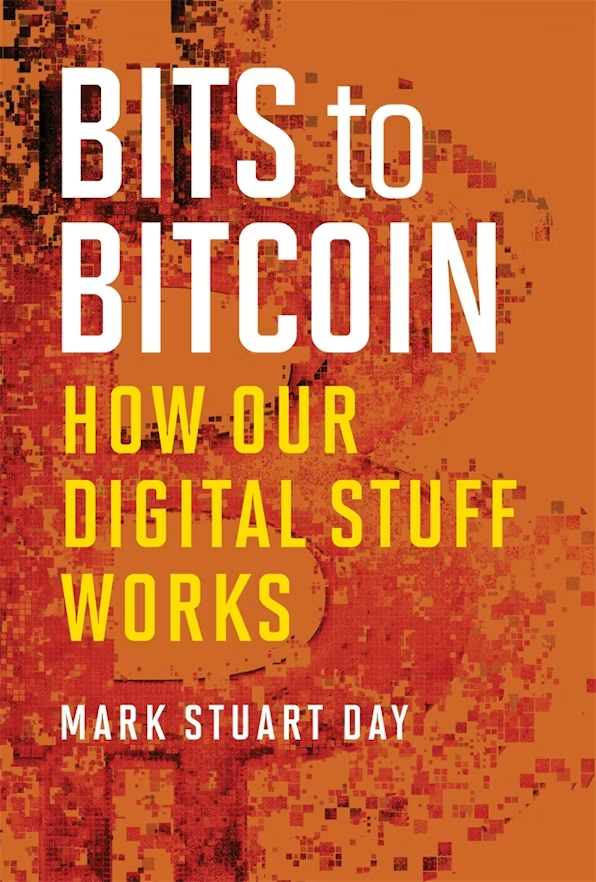 Recommended nextBits to BitcoinMark Stuart DayIntermediate · Long · ContextualNon-programmers who want to understand the infrastructure beneath Bitcoin
 Another perspectiveGrokking BitcoinKalle RosenbaumIntermediate · Long · EssentialVisual learners moving beyond the basics
Lesson summary
Key takeaways
Private keys create signatures that authorise Bitcoin transactions.
Public-key information allows nodes to verify signatures without learning the private key.
Bitcoin addresses are shareable destinations used to receive bitcoin.
A private key should never be revealed to another person or service.
Digital signatures are linked to specific transaction data.
Modern wallets can derive many keys and addresses from one recovery phrase.
A recovery phrase can recreate the wallet and must be protected carefully.
Bitcoin nodes reject transactions that do not provide valid authorisation.